
Figuring out how much water to bring camping is one of those jobs that looks easy until you start packing.
A gallon doesn’t sound like much. Then you remember that a gallon of water weighs about 8.3 pounds, and suddenly ten gallons is more than 80 pounds taking up space in your vehicle. Bring too little, though, and a relaxing weekend can turn into a search for the nearest water spigot.
So how much water do you actually need?
For most car-camping trips, 1 gallon of water per person per day is a useful starting point. The CDC recommends storing at least 1 gallon of water per person per day for emergency use, including drinking, cooking, brushing teeth, and other essential uses. Your real camping needs depend on the weather, how active you’ll be, what you’re cooking, how much cleanup you’ll do, and whether potable water is available at the campsite.
The trick is to use the one-gallon rule as a starting point, then adjust it for the trip you’re actually taking.
Start here: Total water = number of people × number of days × 1 gallon
For example, two people camping for three days would start at: 2 × 3 × 1 = 6 gallons
A family of four on the same trip would start at 12 gallons. That doesn’t mean you will drink 6 or 12 gallons. The figure is a practical planning baseline for drinking, cooking, brushing teeth, and basic sanitation.
There’s also an easy mistake to make with the word “day.” Don’t automatically calculate water from the number of nights. A two-night trip can involve parts of three calendar days, so think about when you’ll arrive, when you’ll leave, and how many meals you’ll actually prepare at camp.
Here’s a quick reference:
| Camping Trip | 1 Person | 2 People | 4 People |
| 1 day | 1 gallon | 2 gallons | 4 gallons |
| 2 days | 2 gallons | 4 gallons | 8 gallons |
| 3 days | 3 gallons | 6 gallons | 12 gallons |
| 5 days | 5 gallons | 10 gallons | 20 gallons |
| 7 days | 7 gallons | 14 gallons | 28 gallons |
These numbers are a starting point for a typical car-camping trip in reasonably mild conditions. They are not a universal hydration requirement.
The biggest mistake in camping water planning is treating one gallon as a fixed answer. Weather and activity can change your needs quickly. A quiet weekend at a shaded campground is very different from spending six hours a day hiking in direct sun.
Heat increases fluid loss through sweating, while strenuous activity increases how much you drink. That’s why the National Park Service recommends carrying plenty of water on longer hikes, with some parks advising hikers to carry at least 1 liter for every 1–2 hours on the trail.
Rather than applying an arbitrary multiplier to every trip, look at three things before you leave.
First, check the weather. A cool spring weekend usually requires less water than a midsummer trip in an exposed campsite.
Second, look at your activity level. If you’re mostly sitting around camp, your baseline may be reasonable. If you’re hiking, climbing, paddling, or doing other strenuous activities, you’ll need a larger reserve.
Third, check your water source. A campground with a confirmed potable-water spigot gives you options that a remote site without a refill point does not.
When those conditions are uncertain, carrying extra is usually easier than trying to save the last gallon.
People tend to estimate drinking water reasonably well and underestimate everything else.
Think about what happens during a normal camping day. You make coffee in the morning, cook breakfast, refill bottles, wash your hands, prepare dinner, clean cookware, and brush your teeth. None of those tasks uses a huge amount of water individually, but together they can take a meaningful portion of your supply.
Cooking is particularly dependent on your menu. A dehydrated meal might need only a few cups of water, while pasta, rice, soup, or a larger family meal can use much more. If you’re making coffee for four people every morning, that adds up too.
Cleanup is another place where a little planning helps. Scraping food from plates and wiping greasy cookware before washing can reduce the amount of water needed for the final wash and rinse. On longer trips, keeping separate water for drinking and cooking versus general cleanup can also make it easier to see how much clean water you actually have left.
The important point is that your camping water supply should be thought of as one total resource with several uses, not just a large bottle reserved for drinking.
The one-gallon rule is most useful for car camping because your vehicle can carry the weight.
A gallon weighs about 8.3 pounds, so even a relatively modest 10-gallon supply weighs more than 80 pounds. That’s heavy, but manageable in a car. You can afford to bring a little extra for unexpected delays, additional cooking, or hotter-than-expected weather.
Backpacking is different.
You generally don’t want to carry several days of water on your back unless you absolutely have to. Instead, plan around the distance between reliable water sources.
For example, if a trail has a dependable water source four hours away, your calculation becomes: water needed to reach the source + a reserve for conditions
rather than simply multiplying the total number of days by one gallon.
That distinction is critical. Before a backpacking trip, check the specific trail or park for water-source information and treatment requirements. Natural water that looks clean isn’t necessarily safe to drink, and some areas require all backcountry water to be filtered or otherwise treated.
As one of the camping essentials, a water container itself is easy to overlook because the water is obviously the important part. In practice, though, the right container can make a camping trip noticeably easier.
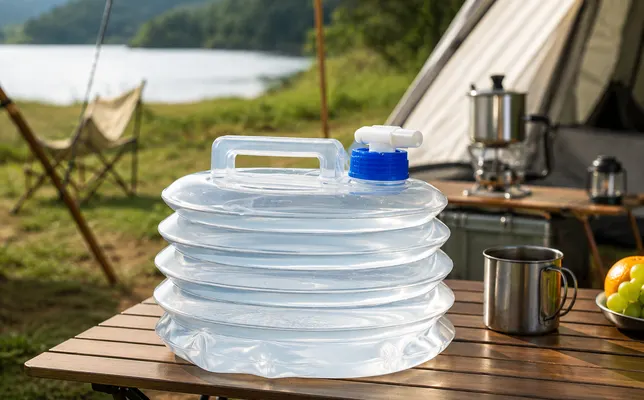
A good camping water container should be designed for water storage, easy to clean, secure when transported, and convenient to dispense. Food-safe construction is important, and the container should remain sealed when it isn’t being used.
There’s another feature that becomes obvious only after the trip: what happens when the container is empty?
I learned this on a three-day, two-night camping trip with two friends. We spent part of the trip hiking and later decided to move to a different campsite, which meant packing everything back into the car. By then, we’d already used nearly half of our water, but the traditional rigid water jug was still taking up almost the same amount of space as when we first loaded it. It also wasn’t particularly convenient for everyday use because it didn’t have a small spigot, so we had to open the main container whenever we needed water for drinking, cooking, or cleaning.
When we started packing for the move, I realized the remaining water wasn’t really the problem. The problem was that the container itself couldn’t get any smaller as the water level went down. With tents, chairs, backpacks, and cooking gear all going back into the car, that unused space became surprisingly frustrating.
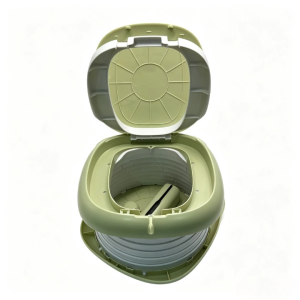
A rigid five-gallon jug can be excellent at the campsite, but it remains a bulky object even after you’ve used much of the water. That’s one reason a foldable water storage bucket can be useful for car camping and road trips. Once the water is gone, the container can be collapsed and stored with the rest of your gear instead of occupying valuable trunk space.
For longer trips, using two foldable containers can also make organization easier. You can keep one for drinking and cooking and another for general camp use, without giving up a large amount of storage space.