
You finish a great home flow. You roll up your mat, lean it against the wall, and walk away. An hour later, it falls over. You step on it while getting water. By morning, the mat is either in the way or forgotten in a dusty corner.
Now imagine a mat that folds into the size of a thick notebook, weighs just over one kilogram, and slides into any drawer or backpack. That‘s the promise of foldable yoga mats — and after testing real products for home use, one design stands out: Foldable Space.
In this guide, we’ll show you the five things to look for in a home yoga mat, and why the Foldable Space 8mm foldable mat might be the smartest fitness investment you make this year.
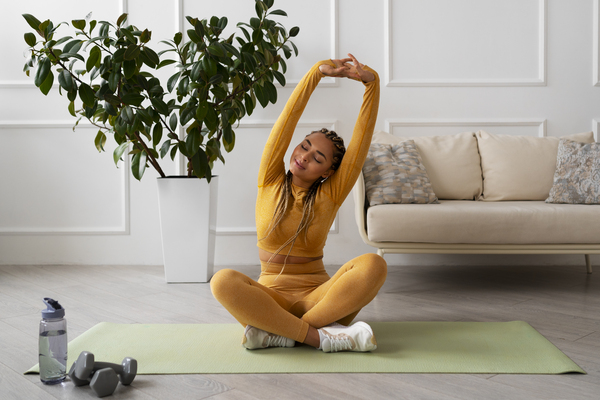
Most yoga mats were designed for studios, not living rooms. A standard rolled mat:
● Takes up valuable floor space
● Falls over constantly on smooth floors
● Picks up dust, pet hair, and humidity
● Is awkward to carry anywhere
A foldable mat solves all of this. You close it, stand it vertically, hang it on a hook, or slip it into a drawer. For anyone in an apartment, studio, or multi-purpose room, foldability directly impacts how often you actually practice.
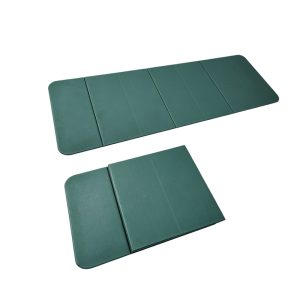
A mat must fold cleanly without permanent creases. Seven-fold designs (like the Foldable Space) reduce the mat to pocket-sized proportions — roughly 30 x 15 x 8 cm when fully folded.
For home use on hardwood or tile, 8mm is superior to thinner mats. It protects knees, wrists, and elbows during lunges, planks, and kneeling stretches. Yet a well-engineered 8mm mat (like Foldable Space‘s POE foam) won’t feel wobbly in standing poses.
Most standard mats weigh 1.8–2.5 kg. A true portable mat should be under 1.5 kg. Foldable Space achieves just 1.028 kg — light enough to carry with one finger, yet substantial enough for real workouts.
Many cheap mats use PVC (smelly, non-eco-friendly). Premium mats use TPE. But POE (Polyolefin Elastomer) is even better — it‘s softer, more flexible, completely odorless, and highly resistant to folding fatigue. It’s also recyclable.
A good home mat needs textured surfaces for dry and sweaty conditions. Width of 61 cm (24 inches) is standard and sufficient for most body types. Length of 180 cm (71 inches) accommodates users up to about 185 cm tall.
My old mat was fine. Until it wasn‘t. It smelled. It slipped when I sweated. And rolling it up? It always fell over.I tried rubber — too heavy. I tried travel mats — too thin. I tried thick cushy ones — too wobbly.I almost gave up.
So what does a good home yoga mat actually look like? For me, it had to be portable, comfortable, and easy to clean. No exceptions.Then I found one that didn‘t ask me to compromise.It‘s called Foldable Space.
So what makes this mat different from all the others I tried?
I‘ve broken it down into six things. Each one solved a problem I didn‘t even know I had.
Unlike 4mm or 6mm mats that leave your knees feeling hard floors, 8mm provides genuine cushioning. You can hold a low lunge for minutes, practice kneeling hip openers, or do abdominal work without a blanket underneath. Yet you won’t feel like you’re standing on a pillow. POE’s responsive rebound keeps you stable in tree pose, warrior III, or any balance posture.
This is one of the lightest full-size yoga mats available. At just over one kilogram, it’s lighter than a MacBook Air — and you carry that everywhere. Toss it into a tote bag for the gym, strap it to a backpack for a park session, or pack it in a suitcase without eating into your luggage weight allowance.
Polyolefin elastomer combines the softness of rubber with the durability of plastic — without the toxic byproducts. No PVC. No latex. No heavy metals. Unroll it fresh from the box: zero chemical smell. It’s also gentle on sensitive skin. No smell. No toxins. No compromise.
Most foldable mats use three or four folds. Foldable Space uses a seven-fold pattern, reducing the mat to a compact rectangle — about the size of a thick hardcover book. Store it upright in a shoe cabinet, lay it flat in a drawer, or hang it on a hook. No more tripping over that annoying tube in the corner of your room.
It’s not the biggest mat. It’s not the smallest. It’s the size that works for most people in most homes — long enough for full stretches (savasana, bridge pose), wide enough for wide-legged stances, and compact enough to not swallow your living room floor.
I used to dread downward dog. Not because of the stretch — because my hands would start sliding halfway through.
No matter what mat I tried, the same thing happened. Dry at first. Then a little sweat. Then my palms creeping forward, my focus breaking, my whole practice falling apart.
I thought maybe I just sweated more than everyone else.Turns out, I was using the wrong mat.
This was my biggest fear with any mat. So I tested it — hard.
| Situation | How Foldable Space Performs |
| Dry hands / feet | ✅ Solid grip. No sliding. |
| Light sweat | ✅ Textured surface channels moisture away. Still stable. |
| Heavy sweat (hot yoga / summer workout) | ✅ POE grips even when wet — tested, hands didn‘t budge. |
| Long practice (45+ minutes) | ✅ No loss of grip over time. |
I kept waiting for it to slip. It never did. I‘ve paid more for mats that slipped worse.This one grips. Who knew a foldable mat would be the answer?
This is why I’ve stuck with this mat for so long. It‘s honestly that good. If slipping has been your thing, give this one a try — and don’t worry about cleaning. A damp cloth does it.
This mat has become my go-to for anything on the floor:
● Post-run stretching
● Bodyweight strength (push-ups, planks, sit-ups)
● Pilates and barre
● Travel workouts
● Meditation and floor stretching
Q: Will an 8mm mat feel unstable in standing poses?
A: Not with POE material. Unlike cheap soft foams, POE has a balanced density — it cushions without excessive squish. Our tests found no instability in warrior II, half moon, or balancing poses.
Q: Are the fold lines noticeable during practice?
A: The fold lines are designed to lay flat within minutes of unfolding. After a few sun salutations, you won‘t feel them. The seven-fold pattern distributes creases across more surface area, reducing any single deep line.
Q: Is this mat suitable for beginners?
A: Absolutely. The 8mm thickness is forgiving for sensitive joints, and the 1kg weight makes it non-intimidating to carry. Many beginners stop practicing because unrolling a heavy, smelly mat feels like a chore — this solves that.
Q: Can I use it outdoors on grass or concrete?
A: Yes. For concrete, the 8mm thickness provides sufficient cushion. For grass, it creates a stable, dry surface. Just wipe it down afterward.
Q: What’s the difference between POE and TPE?
A: POE is a subset of polyolefin elastomers with even higher flexibility and better folding memory. It’s also often more affordable while maintaining eco-friendly credentials.
You don‘t need a dedicated yoga room to have a consistent practice. You just need equipment that works with your space — not against it.The Foldable Space Yoga Mat delivers:
It’s not the only foldable mat on the market. But it is one of the very few that prioritizes real home needs — small space storage, true portability, and genuine workout performance — without compromise.Stop tripping over rolled-up mats. Stop skipping workouts because unrolling feels like a chore.
Visit your preferred marketplace to find the Foldable yoga mat today. Roll less. Practice more.