
Choosing between hard shell and soft shell luggage can be harder than it looks. Both can work well, but they are designed around different priorities. Hard shell luggage offers a more rigid structure, while soft shell luggage tends to be more flexible and easier to access.
So, which one should you choose? It really comes down to how you pack, where you travel, and how you use your suitcase once you arrive.
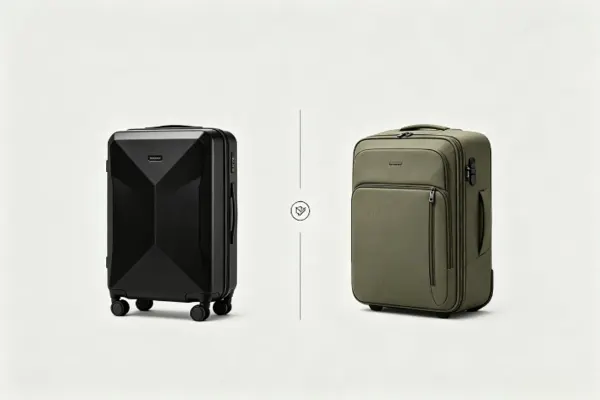
The biggest difference is how the suitcase behaves during a trip. Here is a quick comparison between the two:
| Feature | Hard Shell | Soft Shell |
| Material | Polycarbonate, ABS, aluminum | Nylon, polyester |
| Protection | More rigid structure; better at maintaining shape | Flexible structure; can compress around contents |
| Weight | Varies by material and construction | Varies by fabric and hardware |
| Packing | Structured | More adaptable |
| Expansion | Model-dependent | Common |
| External pockets | Limited | Usually available |
| Water resistance | Exterior is easier to wipe and less absorbent | Fabric can absorb moisture unless treated |
| Cleaning | Easy to wipe | More difficult |
| Opening | Often opens like a clamshell | Many models allow top or partial opening |
| Best for | Protection and checked luggage | Flexible, accessible packing |
Neither option is definitely better. However, the right choice depends on which features matter most during your trips.
The easiest way to choose is to start with the kind of trips you take most often.
Hard shell is a good fit when structure and protection matter more to you than flexibility.
Soft shell makes more sense when access and adaptability are part of your normal travel routine. There is one more thing worth checking before you make a decision: the empty weight of the suitcase.
A lighter case leaves more of your airline’s baggage allowance for the things you actually want to bring. However, do not assume that every softside suitcase is lighter than every hard shell. Materials, wheels, frames, pockets, and expansion systems can all change the final weight.
For carry-on travel, compare the specific suitcase’s full outside dimensions and empty weight instead of relying on the size printed in the product name.
One practical difference people often overlook is how much floor space a suitcase needs when it is fully opened.
A typical 50/50 hard shell suitcase needs room for both halves. That isn’t a problem in a spacious hotel, but it can be frustrating in compact city hotels where the bed, desk, and bathroom already occupy most of the floor.
Some soft shell suitcases use a top-opening design, so you can access the main compartment without laying the entire suitcase flat. This doesn’t mean every soft suitcase is more space-efficient. Design matters more than the material itself.
If you regularly travel through cities such as Tokyo, London, or Paris and change accommodations frequently, consider where you’ll actually open your luggage. A suitcase that works perfectly at home can feel completely different when you’re unpacking beside a hotel bed with barely enough room to walk around.
A hard exterior doesn’t automatically make luggage more secure. Both hard and soft suitcases can use zippers, and a zipper lock shouldn’t be considered a complete anti-theft solution. If security is a priority, look at the closure itself. Frame-and-latch designs eliminate the conventional zipper from the main opening, which some travelers may prefer for added structural security.
Hard shell luggage also has a practical advantage when it comes to cleaning. A smooth exterior is generally easier to wipe and inspect than fabric. That can be useful for frequent travelers concerned about hotel pests such as bed bugs. However, no suitcase material is completely resistant to them. Wheels, seams, handles, and interior areas can still provide hiding places.
Keeping luggage off the bed and inspecting it after travel are more important precautions than simply choosing one material over another.
For frequent flyers, empty suitcase weight and external dimensions may matter more than whether the luggage is hard or soft. A lightweight case leaves more of your airline allowance available for clothing and other belongings. This is particularly useful when flying with strict carry-on or checked-baggage limits.
Soft luggage often has an advantage because its flexible construction and expansion sections can accommodate additional items. But expansion can also increase the suitcase’s dimensions, so you should check the airline’s current limits before using it.
If you regularly return from trips with more than you left with, expandable luggage can be especially useful. The key is to distinguish between more capacity and more permitted capacity. A suitcase can physically hold more without giving you permission to exceed the airline’s weight or size restrictions.
Also Read: Can You Put a Laptop in a Checked Bag? Everything You Need to Know Before Flying
“Hard shell” and “soft shell” are broad categories. The actual material still makes a big difference.
Polycarbonate is widely used because it combines a rigid structure with some flexibility. It is a common choice for travelers who want a structured suitcase without an especially heavy metal shell.
Polypropylene is another common option and can be useful when keeping weight down is a priority.
ABS is often found in more affordable luggage. However, the material name alone does not tell you how well a suitcase will hold up. Shell thickness, corner construction, wheels, handles, and other hardware matter too.
So, rather than asking only whether a suitcase is hard shell, look at how the whole case is built.
Softside luggage is commonly made from nylon or polyester. Their performance can vary depending on the fabric, weave, stitching, and overall construction. Again, the outer material is only one part of the picture. Check the zippers, seams, wheels, handle, and areas that are likely to take the most stress.
That is why a well-made softside suitcase can sometimes be a better choice than a poorly built hard case, even though the two designs have very different exteriors.
For carry-on luggage, there is one more specification worth checking: actual exterior dimensions. Do not rely only on labels such as “20-inch” or “21-inch.” Airlines can have different size limits, and wheels and handles may be included in the measurement. Check your airline’s current baggage rules before buying.
You do not always have to choose between a completely rigid suitcase and a completely flexible one.
Hybrid luggage combines features from both designs. Depending on the model, you may get a more structured body together with flexible fabric sections, expandable storage, or easier-access compartments. This can work well for travelers who want more structure without giving up all of the flexibility of a soft side case.
You can also consider an expandable carry-on luggage, which is designed around that idea, giving you a more compact starting size with extra storage when you need it. That can be especially useful when your return trip includes shopping, souvenirs, or simply more things than you packed at the beginning.
In the end, there is no single winner in the hard shell vs soft shell luggage debate. Choose hard shell when you want a more structured case and stronger protection around your belongings. Choose soft shell when flexibility, easy access, and adaptable packing are more important.
Either way, look beyond the shell itself. The suitcase’s weight, dimensions, opening style, storage layout, wheels, and overall construction will have a big effect on how useful it feels once you are actually traveling.