
Camping gear has a habit of taking up more room than expected. A water container, bowl, cup, stool, and storage box may seem manageable individually, but together they can quickly fill a backpack or car.
The problem gets worse when these items stay full-sized even when they are empty or not in use. Fortunately, foldable camping gear can solve these. But simply choosing foldable gear can also lead to overpacking if you bring more items than you actually need. Read on to find out what you really need for a camp trip.
The right foldable gear depends on how you camp. A backpacking trip has very different packing needs from a weekend at a campsite.
When everything goes into your backpack, saving space only helps if the product does not add unnecessary weight. Collapsible bottles, cups, and compact food containers can work well because they are used regularly but do not need them to stay full-sized while packed.
Water storage is a good example. If your route has reliable refill points, a smaller collapsible bottle may be more practical than carrying a large-capacity container. You reduce both the weight of the water and the space taken up by the empty bottle.
For backpacking, compare weight first and packed size second. A product that saves considerable space but adds too much weight may not be a good trade.
Car campers can usually carry heavier equipment, but the amount of trunk space remains limited. This makes larger foldable gear more useful, especially when an item becomes much smaller after its contents are gone.
Water containers are also essential. A rigid container can take up the same amount of space whether it is full or empty. A collapsible alternative can provide the capacity you need at camp without permanently occupying that volume in your vehicle.
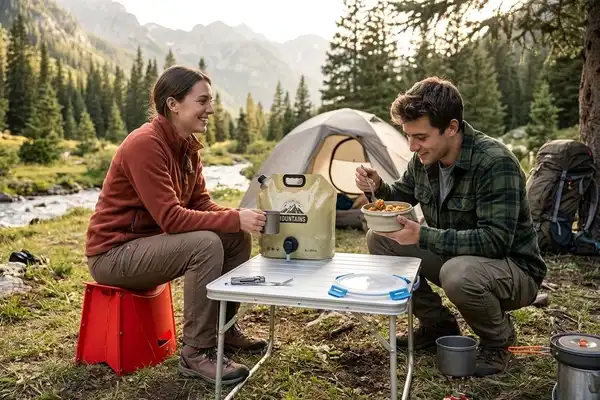
A foldable water bag, which holds up to 8 liters and weighs about 105 g can be a practical option. Its reinforced base helps it stay upright when filled, while the adjustable-flow spigot can be used for drinking, washing, or camp cooking.
Its main advantage is not simply its capacity. It turns from a large water-storage item into a much smaller piece of gear once the water is gone. This can be especially useful on the way home, when used clothing, food containers, and other gear compete for the same trunk space.
For a one- or two-night trip, the problem is often carrying too many separate items rather than carrying too much weight. Choose gear that performs a common function without creating extra setup or storage work.
A collapsible camping bowl is a good choice. It provides a structured bowl when open but takes up less vertical space when packed. This makes it easier to fit into a compact camping kitchen or day bag.
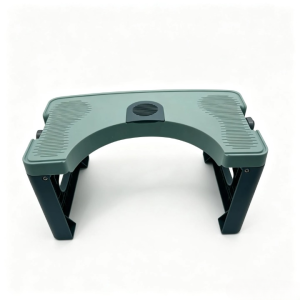
The same idea applies to seating. If you only need somewhere to sit while cooking, changing shoes, or taking a short break, a full-size chair may be unnecessary. Take a look at a foldable sheet stool, which weighs approximately 244g and folds to around 13cm thick.
However, compact does not always mean better. If you plan to sit for hours, comfort should matter more than minimum packed size. For occasional seating, portability may be the more useful feature.
Family camping creates a different storage problem because several people may use the same equipment. Instead of choosing the smallest possible products, prioritize gear that provides useful shared capacity without creating unnecessary bulk when stored.
A larger foldable water container, for example, can serve as a shared water source for drinking, cooking, and basic cleaning. Do not choose a container purely because it folds into a tiny package. If it is too small for your group and needs constant refilling, the space saving may create more work. For family camping, capacity-to-storage efficiency matters more than absolute compactness.
The fact that something folds does not automatically make it worth carrying. Before adding foldable gear to your camping list, consider how much space it saves, how much it weighs, and whether it still works well when opened.
Look at the actual folded or collapsed dimensions rather than relying on words like “compact” or “space-saving.”
Ask yourself: How much space will I actually recover?
A water container that becomes much smaller when empty has a clear advantage. If folding only reduces an item’s size slightly, the extra weight or complexity may not be worth it.
This is especially important for backpacking. A lightweight product that saves a modest amount of space may be more useful than a heavier product with a smaller packed size. For car camping, however, a heavier item can still make sense if it frees significant trunk space. The right trade-off depends on how you transport your gear.
A product still needs to do its main job properly when opened. Check its stability, capacity, weight limit, ease of cleaning, and how well it performs in real camping conditions. A foldable water container should remain stable when filled, while a folding stool should be secure within its stated load capacity.
The goal is not the smallest packed product. It is the smallest product that still works well.
The easiest way to save space is sometimes to bring fewer things. Before packing an item, ask what specific problem it solves. If another piece of gear already performs the same function, carrying both may add bulk without adding much value.
This is especially common with cooking utensils, food containers, extra clothing, and small accessories. The goal is not to build the smallest possible camping kit. It is to build the smallest kit that still covers the important functions of your trip.
Safety equipment is different. First-aid supplies, reliable lighting, navigation equipment, weather protection, and emergency supplies may remain unused during a successful trip, but that does not make them unnecessary.
A useful rule is: Remove duplicate functions, not essential functions.
The best foldable camping gear is not necessarily the smallest product or the one with the most features. It is the gear that performs an important function while taking up significantly less space when that function is no longer needed.
Before buying a foldable product, ask:
If the answer makes sense for your camping style, the gear has earned its place. Smart packing is not about owning more compact products. It is about making every piece of gear earn the space it occupies.