
Looking for the best neck pillow for travel? Every travel pillow review tells you to buy this one, not that one. But have you noticed that most of those recommendations come from people who’ve only used the pillow once or twice? The real test is a long-haul flight, a layover delay, or a night spent dozing on an airport bench — and whether you’d still reach for that pillow again.
I’ve bought over a dozen travel pillows. Most of them ended up in a closet after one or two trips. Not because they looked bad — because they simply didn’t work. It wasn’t until I figured out one thing: the problem wasn’t the pillows. It was the way I’d been choosing them.
What’s the most common mistake people make when picking a travel pillow? It’s not ignoring reviews. It’s not being cheap. It’s confusing “looks comfortable” with “actually works.”
Those fluffy, squishy pillows that sink when you press them do feel tempting on the store shelf. But what you need on a plane isn’t “soft” — it’s “support.” Those are two very different things.
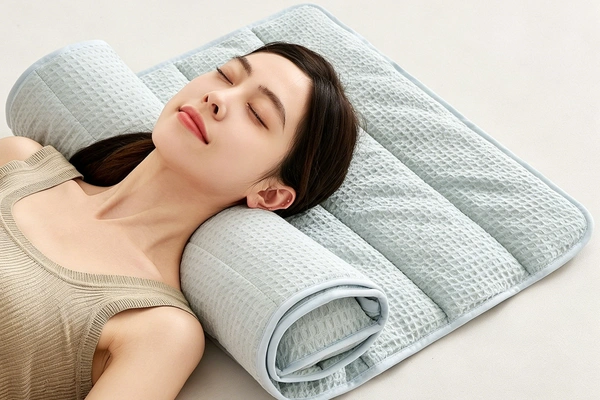
You’re not sitting on your living room couch. Airplane seats already tilt forward slightly, and your head naturally weighs more than you realize. Your neck spends the whole flight doing static work against gravity. Without proper support, that constant tension builds up, leading to neck pain that can last for hours or even days after you land. What you need is something that helps share that load — not a soft cushion that lets you sink in and makes your neck muscles work even harder. A welldesigned pillow should also provide chin support, keeping your jaw aligned with your spine so your head doesn’t droop forward or tilt sideways during sleep. Without it, even the plushiest pillow fails to prevent that familiar travel-day stiffness.
Another common mistake is ignoring your height. A 160 cm person and a 185 cm person sitting in the same row have completely different headrest positions. If your neck sits higher or lower than the built-in headrest, no U-shaped pillow can save your cervical spine.
So when choosing a travel pillow, there are really only two things that matter: whether the support design makes sense, and whether it can adapt to your height. Everything else is secondary.
Memory foam U-pillows — comfortable for the first month, then they start losing shape. And they’re bulky. Hanging one off your bag feels like carrying extra luggage.
Inflatable pillows? Light and compact, sure. But leaking air is a constant risk, and the crinkling sound every time you shift your head gets old fast. The bead-filled or buckwheat ones offer decent support, but moving your head sounds like shaking a maraca.
The problem with most of these pillows is the same: they try to force every person into one preset shape. But everyone’s neck, shoulders, and seat angle are different. When you force your body to fit the pillow instead of the other way around, it’s never going to work well.
I was sitting in an airport lounge, waiting for a connecting flight, and I rolled up a small towel to tuck behind my neck. It felt surprisingly good. Soft enough, adjustable, breathable — and it didn’t trap heat.
Later I found out there’s actually a travel pillow designed around this exact idea: the towel travel pillow.
It’s not a pillow in the traditional sense. It’s a long strip of towel fabric with an adjustable strap system. You roll it to the thickness you want and adjust the support position — just like you would with that towel at the airport. You want it higher? Roll it tighter. Lower? Loosen it up. The material is soft and breathable, so you won’t end up with a sweaty neck mid-flight.
Most importantly, it solves a problem that no traditional travel pillow ever could: it adapts to your height and your seat angle, on the fly.
A lot of so-called “ergonomic” pillows are designed for one ideal sitting posture. But you don’t sit in that perfect posture for the whole flight. You slide down a bit. You lean toward the window. You lean forward to eat — and every single movement changes the angle your neck has to hold.
The towel travel pillow works differently because it doesn’t lock you into one position. The softness is calibrated so that when you shift, the pillow shifts with you, maintaining contact with your neck curve rather than fighting it. The anti-tension principle here is simple: the rolled fabric creates a supportive arc at the back of your neck, letting your head rest slightly higher than your chest, instead of being pushed forward by the seatback.
And because you control the thickness and roll tightness, whether you’re 160 cm or 185 cm, you can adjust it to fit you.
This travel pillow isn’t just for your neck. Roll it up and it supports your cervical spine; unfold it completely and it becomes a small sleeping mat – great for airport naps, lounging outdoors, or adding a clean layer on a hotel bed. The quick-dry fabric also works for a quick wipe of your face or hands (not a real towel, just handy in a pinch). Roll it a different way and it turns into a lumbar cushion. Rest your legs on it, lean against it as a backrest, or spread it out as a makeshift mat – it adapts to whatever you need at the moment.
Here’s the part that actually makes a difference: it’s machine washable. Traditional memory foam pillows? They fall apart or turn into crumbly lumps the moment they get wet – you can only spot-clean the cover, never the core. This one is made entirely from fabric, so you can just toss it in the washing machine whenever it gets dirty – from airport floors, hotel beds, or just a long day of travel. Wash it, air-dry it, and it comes out fresh and ready for your next trip. No lingering smells, no loss of support. One item, multiple uses. Less luggage, more freedom on the road – and cleaner, too.
If your current pillow works fine, there’s no need to switch. But if you always end up with a stiff neck after a flight, or if you’ve never found a travel pillow that actually fits your height, a towel-based adjustable design is worth a try.
Here’s how I use mine: when I board, I roll it to the right thickness and tuck it behind my neck. If I’m not sleeping after takeoff, I loosen it and use it as a regular backrest. When I want to sleep, I roll it tighter again. No assembly, no digging through my bag to pull it out and put it away.
One sentence to sum it up: what you probably need isn’t a more expensive pillow. It’s a more flexible approach.