
How to pack a foldable yoga mat for travel? I used to skip packing my yoga mat when I traveled. Not because I didn‘t want to practice — because rolling it up felt like fighting a sleeping bear. It wouldn’t fit in my suitcase. It flopped out of my backpack. And by the time I wrestled it into some semblance of order, half my bag was full and I‘d lost the motivation to practice anyway.
Sound familiar?Here‘s the truth: you don’t have to leave your mat behind. You just need to pack it right. Whether you‘re heading to a weekend retreat, a week-long work trip, or just across town, there’s a way to bring your practice with you without the headache.Let me show you what I‘ve learned — from years of shoving mats into overhead bins, stuffing them into carry-ons, and finally finding a smarter way to travel with one.
When you’re packing for a trip, the last thing you want is your mat rubbing against your clothes. So before you pack, just give it a quick wipe. Sweat, dust, and whatever’s on the floor shouldn’t end up on your clothes. A damp cloth with a little water is all you need – just pay extra attention to the edges and corners, since that’s where grime tends to hide.
Make sure it’s completely dry before you put it away. If you pack it while it’s still damp, it’ll start to smell – and once that happens, it’s hard to get rid of on the road. If your mat is made from a closed‑cell material like POE or TPE (thermoplastic elastomers), it doesn’t soak up much moisture to begin with, so a quick wipe dries in minutes and you’re good to go. By contrast, open‑cell mats made from natural rubber tend to absorb sweat and moisture more readily, taking much longer to dry – which makes them less ideal for travel. Keeping your mat thoroughly dry isn’t just about convenience; it also preserves its antimicrobial properties and ensures better hygiene, especially when you’re placing it on hotel floors where cleanliness is unpredictable.
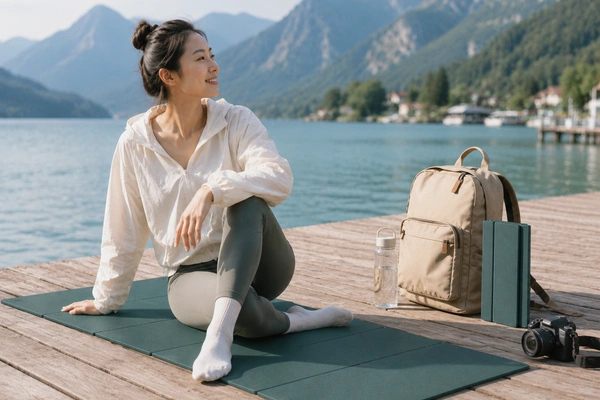
This is where most of us get stuck. Should you roll it or fold it? The answer depends on your mat, your bag, and how much space you have. Here‘s a quick tips to help you decide.
For thick or bulky mats (6mm and up) – Rolling is usually your only option. Thick foam doesn’t like to fold. Roll it tightly from one short end to the other. Store the rolled mat in a dedicated carrying bag or strap it to the outside of your backpack. Just know that a rolled mat takes up a lot of space — especially in a carry-on.
For thin mats (3–4mm) – You have more flexibility. A thin mat can fold into tidy squares. Fold it in half lengthwise first, then fold into halves or thirds. A 4mm mat can often fit inside a backpack without bulging out. However, portability isn’t everything – you also need to pay attention to density and cushioning. On hard hotel floors, a low‑density thin mat won’t provide enough impact absorption, and your knees, wrists, and other joints will feel every bit of that hard surface beneath. A well‑cushioned mat with the right density helps protect your joints during practice, making your travel yoga sessions comfortable rather than painful.
For foldable mats designed to fold – This is where things get interesting. Some mats are made to fold, not roll. They use materials that won‘t crack or crease permanently. The difference is night and day when you’re packing for a trip.
If your mat folds (like the Foldable Space Mat), folding is the way to go for travel. Rolled mats are fine for home storage, but when you’re packing light, folding saves a lot more room. Here’s a quick comparison:
| Packing method | Pros | Cons |
| Roll it | Familiar, works with most mats | Bulky, hard to pack in small bags, tends to unroll |
| Fold it | Compact, fits in suitcases and backpacks | Not all mats can handle folding |
| Square fold | Turns into a flat rectangle, lays flat in luggage | Requires a thin mat or one designed for folding |
If your mat is foldable, here’s how to do it for travel.
For suitcases, use the quick square method – lay it flat, fold lengthwise, then crosswise into a square. If your bag is small, fold it again.
For backpacks, try the accordion – fold one short end toward the center like a letter, fold the other end over it, and keep alternating until it’s stacked.
For mixed use, roll it loosely, then fold the rolled mat in half and secure it with a strap.
One thing to keep in mind – if your mat is thicker than 6mm, don’t force a sharp fold, or you’ll damage it over time. Traditional PVC (polyvinyl chloride) mats or any thick, nonfoldable design aren’t engineered to bend that way. Folding them repeatedly creates stress lines that can crack the surface layer and compromise the nonslip texture, reducing the mat’s overall surface grip and traction. Once the grip is compromised, your hands and feet can slip during practice – especially in sweaty conditions, which defeats the purpose of having a travel mat in the first place. For mats 8mm or thicker, rolling is safer unless the manufacturer explicitly states they are foldable. This is exactly why a purposebuilt foldable thick mat – with the right material formulation – outperforms traditional rolled PVC mats on the road.
The cushion is folded. Now, how should we place it to save space and avoid hassle? Different package types require different solutions. Among the following methods, these are the ones I use most frequently.
In a carry-on, lay it flat at the bottom before you add clothes – it gives you a solid base and keeps the mat from moving around. If it’s thin enough, slide it into the laptop compartment. This flat‑packing method isn’t just about organization – it also protects the mat’s surface from creases. When you arrive at your destination and roll out your mat for an intense Vinyasa flow or a sweaty Hot Yoga session in your hotel room, the last thing you want is a deep fold line that weakens the grip. During poses that demand serious traction – like Downward‑Facing Dog (Adho Mukha Svanasana), where your hands and feet bear your full body weight – even a slight loss of surface stability can cause your palms to slide forward mid‑breath, breaking your focus and potentially straining your wrists. Keeping the mat flat ensures that every inch of its non‑slip surface is ready to perform exactly when you need it most.
In a backpack, slide it against the back panel behind your clothes – it adds some padding and keeps the weight centered. For side-access packs, a tightly rolled mat can tuck into the water bottle pocket.
In a duffel or weekender, folded mats sit nicely against the flat side of the bag. Put heavier things like shoes or toiletries on top to keep everything compressed. One more thing – use the mat as a barrier between dirty shoes and clean clothes. Two birds, one stone.
Soon as you get there, don’t leave the mat stuffed in your bag. Unroll it or lay it flat for an hour – it needs to breathe, especially if it’s been folded tight. If you’re in a hotel, hang it over a chair or the shower rod. And if it’s foldable, just unfold it and wait a bit – creases disappear on their own. By the time you’ve settled in, it’s good to go.
After years of traveling with a mat, I’ve learned that the best way to pack one is to just get one that’s actually designed for travel.A standard 6mm mat works fine at home. But on the road? It’s heavy, bulky, and a hassle to deal with.
That’s why I switched to a foldable one – like the Foldable Space mat, which folds down to about the size of a thick book and weighs a bit over a kilogram. Light enough that I don’t think twice about tossing it in my bag.It slides into my backpack’s laptop sleeve, or fits flat at the bottom of my carry-on. No strapping things to the outside of my bag, no worrying about it falling off at the airport.When I arrive, I unfold it – and within a minute, the fold lines are gone. No waiting, no practicing on creases.That’s the main advantage of a travel-friendly mat.
One last thing – don’t let packing get in the way of your practice. A clean, folded mat takes up less space than you’d expect, especially if it’s designed to fold. Next time you pack, give it a try – fold it, pack it flat, and air it out when you get there.If you’re tired of wrestling with a mat that wasn’t made for the road, it might be worth trying one that is. Your practice shouldn’t be left behind – fold it up and bring it along.