
There is a simple answer to how much space does a cat need: there is no accurate square-foot number that works for every cat.
A better way to judge your home is to ask what the cat can actually do there. Can it leave a busy area? Can it find somewhere quiet to sleep? Can it climb, hide, play, scratch, and reach its litter box without being blocked by people or another pet?
That matters because cats don’t use a home evenly. A 500-square-foot apartment may look spacious on a floor plan, but if the cat’s bed, food, litter box, and scratching post are all crammed into one corner, most of that space isn’t doing much for the cat.
Feline veterinary guidance focuses on the quality and arrangement of the environment, including safe places, vertical territory, separated resources, and opportunities for play and normal behavior.
So the useful question isn’t “How many square feet does my cat need?”
It’s “How much of my home can my cat comfortably use, and how many choices does that space give it?”
For many cats, yes. But the number itself doesn’t tell you whether a home is suitable.
There is also an important reason not to rely on the small square-foot figures you may find online. USDA regulations specify minimum enclosure requirements for cats housed in regulated facilities, including minimum floor area and enclosure height. These standards are regulatory minimums rather than a recommended amount of living space for a household cat.
For a household cat, look at your floor plan differently.
Imagine a 500-square-foot studio with one couch, one bed, one litter box beside the kitchen, and no elevated areas. On paper, it sounds roomy. In practice, the cat has very few distinct places to go.
Now add a cat tree by the wall, a covered hiding place behind furniture, an open strip of floor for play, and a litter box in a quiet location away from food. The apartment is exactly the same size, but the cat has more usable territory.
This is why layout beats raw square footage in many small homes.
A useful rule of thumb is to count functional areas rather than rooms:
These don’t need to occupy six separate areas of your home. They just need to be available and reasonably accessible.
When people ask how much space a cat needs, they’re usually imagining a number on a measuring tape.
Cats don’t experience your apartment that way.
A better test is whether the cat has options.
Can it choose the sofa or a high perch? Can it disappear behind something when guests arrive? Can it walk away from another cat instead of being forced into a corner? Can it get to the litter box without walking through a noisy or heavily used area?
This becomes especially important with essential resources. International Cat Care recommends giving cats multiple resources and spreading them through the home rather than concentrating everything in one location.
That means your 450-square-foot apartment may work better when resources are distributed across it instead of creating one giant “cat station.”
For example:
Bedroom: quiet sleeping area or hiding place
Living room: elevated perch and scratching area
Window: observation spot
Bathroom or quiet corner: litter box
Open floor: interactive play
You haven’t increased the size of the apartment. You’ve increased the number of ways your cat can use it.
A small apartment has one advantage people often overlook: you have walls.
Cats can use elevated surfaces as resting and observation points, which means useful territory doesn’t have to come entirely from the floor. Veterinary guidance for indoor cats specifically includes vertical territory as part of an appropriate environment.
This doesn’t mean you need a floor-to-ceiling cat jungle.
One sturdy cat tree, shelf, or window perch can create a completely different option from a floor-level bed. A high resting place is particularly useful when the home gets busy because the cat can stay involved without sitting in the middle of the traffic.
There is another practical benefit: vertical space costs less floor area.
If you have a very small apartment, prioritize one good elevated location before buying several low beds. A single vertical structure can provide climbing, resting, scratching, and observation in the same footprint.
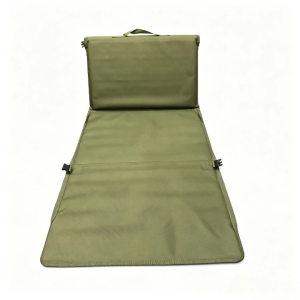
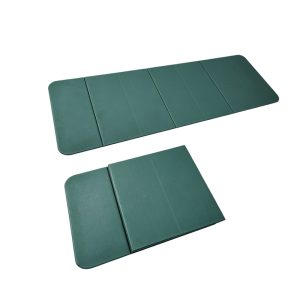
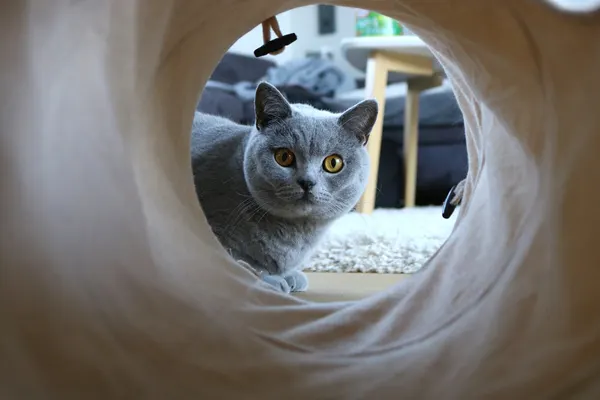
For play and hiding, flexible equipment can make the same principle work on the floor. A collapsible cat tunnel can create a temporary covered route for chasing and hiding, then fold flat when the room needs to serve another purpose.
That’s useful in small homes because your cat’s environment doesn’t have to stay physically identical all day.
Two cats don’t automatically require twice the floor space.
What matters first is whether they can share the home without constantly competing for the same resources.
This is where owners sometimes make a practical mistake: putting everything in one place.
Two food bowls beside each other. Two beds beside each other. One cat tree. Two litter boxes next to one another.
It looks like a generous setup from a human perspective, but it can create a bottleneck for cats.
A better approach is to spread important resources around the home so one cat can’t easily control access to everything. This is consistent with current feline guidance on reducing tension in multi-cat households.
For litter boxes, a common starting point is one box per cat, plus one extra. For two cats, that means three boxes when the home can accommodate them. Placement matters as much as the count: quiet, accessible locations are preferable to putting all three together.
The real question isn’t “Do I have enough square feet for two cats?”
It’s “Can both cats get distance from each other when they want it?”
You don’t need to dedicate an entire room to your cat. Start with four improvements that give you the biggest return for the space you have.
A box, covered bed, or tunnel tucked into a quiet area can give the cat somewhere to retreat. A hiding spot in the middle of a walkway isn’t really private, no matter how cute it looks.
A window perch or compact cat tree gives the cat a different level without taking over the floor.
Don’t automatically put litter, food, water, bed, and scratching post in the same corner just because it is convenient.
You don’t need an empty living room. You do need enough room for a cat to chase a toy, turn, pounce, and move at speed.
The mistake to avoid is buying more and more cat furniture until the apartment becomes harder for both of you to use.
The goal is more useful territory, not more stuff.
Read more: How to Organize a Small Apartment Without Making It Feel Smaller
Before deciding that you need a larger apartment, walk through your home and test five things.
There should be somewhere it can retreat without being constantly approached.
A secure elevated resting point adds another layer of territory.
The route should be accessible, quiet, and not easily blocked by another pet.
Food, water, toileting, resting, scratching, and hiding opportunities should not all depend on one tiny corner.
This is especially important in multi-cat homes. A cat that can leave a situation is generally in a much better position than one that is forced into a dead end.
If your home passes these five tests, square footage may not be your biggest limitation.
Your next improvement is probably environmental variety rather than a bigger lease.
There are cases where space really does become a limitation.
If a cat has no quiet place to retreat, no opportunity to move away from another animal, and no room for normal activity, adding enrichment may only go so far.
Watch the cat rather than relying on the floor plan. Persistent hiding, conflict between cats, house-soiling, excessive grooming, or other changes in behavior deserve attention. But don’t automatically assume a small apartment is the cause: behavior changes can also have medical explanations.
For example, litter-box problems should not simply be treated as a space issue without considering health, while excessive grooming may have more than one possible cause. Veterinary evaluation is appropriate when changes are sudden, persistent, or significant.
In other words, a small home can be workable, but a stressful home cannot be fixed by pretending the square footage doesn’t matter.
The environment has to function for the individual cat.