
The kitchen, as one of the most important spaces in a household, becomes uncomfortable to cook in if it is not clean. I am one of those people who feel this way. The kitchen is a place that needs to be cleaned every day, and it is not an exaggeration to say that it needs to be cleaned at least three times or more a day. Some people even have afternoon tea or late-night snacks. When the kitchen counter and drawers get messy, it feels like the entire house is dirty and even smelly. How to tidy up and clean the kitchen and how to organize the drawers is a very frustrating task. The kitchen drawers, although not very large, every time I open them, my emotions are always complex. I clearly remember putting it in last time, but now I just can’t find it. I searched through it but couldn’t find it. I searched again but still couldn’t find it. Finally, I had to squat down and stick my head in to look, and I discovered it lying at the very back of the drawer, blocked by something that I don’t know when was put there. If you are cooking at this moment and are flipping the pan in your hand, and you really need this thing, it would be a disaster. Not only would you be very irritable, but the entire cooking rhythm would also be disrupted.
After a while, I started thinking seriously about why drawers are so frustrating to use. It’s not because they’re small, but because they end up filled with an odd mix of things—spatulas next to bag clips, peelers pressing down on measuring cups, baking molds tangled with bottle openers, plus leftover condiment packets from takeout orders. Every time I need something, I have to rummage through the whole drawer. These items vary in size, shape, and how often they’re used. Shoving them all together makes it hard to pull something out and even harder to put it back neatly. Over time, the drawer becomes more like a junk pile than a functional storage space. That’s why, when it comes to kitchen organization, the drawers are where I started.
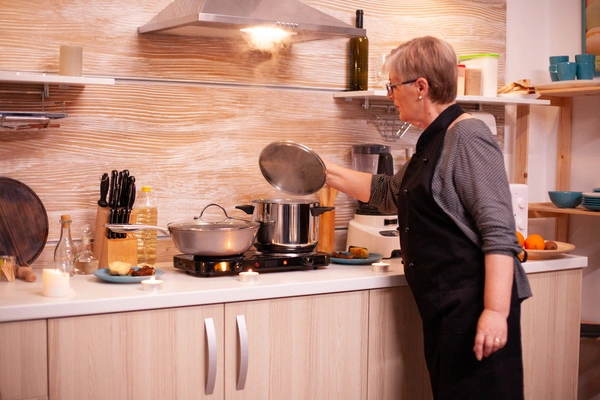
A messy drawer often doesn’t have a clear purpose. Anything gets tossed in, and over time it becomes a catch-all instead of a functional zone. I looked at a bunch of kitchen organization ideas and noticed that people who use their drawers well assign a specific function to each one. The drawer closest to the stove holds only cooking tools—spatulas, ladles, slotted spoons, tongs. The drawer near the prep area holds prep tools—peelers, graters, measuring spoons, bottle openers. Small items go in a separate spot—bag clips, timers, piping tips don’t get mixed in with larger pieces. Once you give a drawer a purpose, you always know where things go, and you’re less likely to toss things in at random.
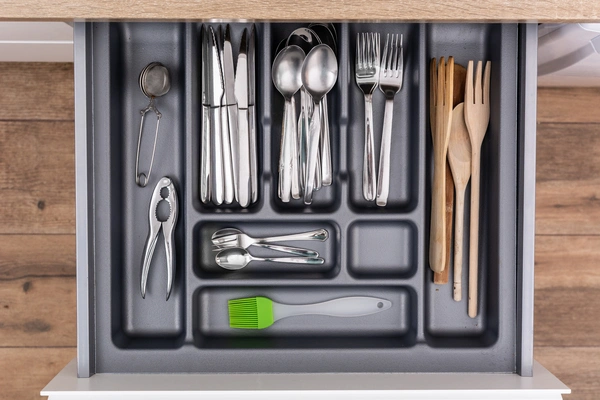
I use the kitchen often, so I’ve noticed a pattern. I don’t know if you’ve seen it too, but when things are laid flat in a drawer, the drawer is almost always a mess. Flat items don’t have clear boundaries—they slide around when you open the drawer, shift, and end up pressed against other things. Also, laying things flat doesn’t make good use of the available space.
Later on, I started using dividers to section off the drawer into smaller compartments, each holding one type of item. Spatulas stand upright in a row, peelers and graters sit in a small section, and bag clips and timers go in a little box. Once everything has its own spot, you don’t have to dig, and you don’t have to think about where to put things back. Over time, you just know where everything is at a glance, and you stop wasting time searching.
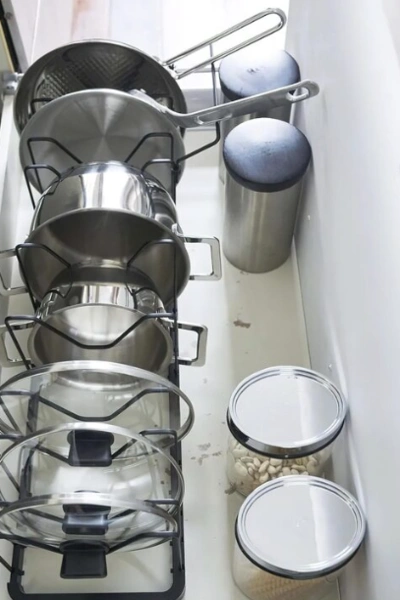
Lid racks, baking sheets, and cutting boards—these flat items used to be stacked on top of each other. But that meant that to get the one at the bottom, I had to move everything else out of the way. Then I started storing them upright. Using dividers, I stood them like books on a shelf. Everything is visible, and I can pull out what I need without disturbing the rest. It’s the same with pots and pans. Frying pans, stockpots, and saucepans stacked together made it hard to reach the one at the bottom. Now I use an adjustable pot rack to stand them upright, one by one. I can grab whichever I need without touching the others. Frequently used pots go in front, less-used ones in back. For lids, I use a tension rod inside the cabinet door, tucking them upright so they don’t take up counter or drawer space. Whenever I grab a pot, the right lid is right there.
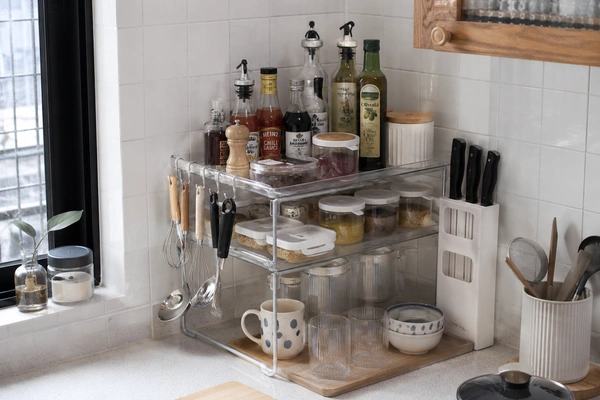
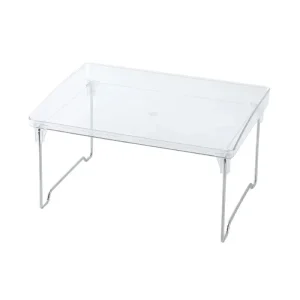
Corner spaces—whether cabinet corners or dead zones on the countertop—are easy to overlook. These areas are often L-shaped or awkward to fill, but with the right tools, they can be put to good use. A simple multi-tier countertop shelf can transform a forgotten corner. It doesn’t take up floor space; it grows upward. The bottom level holds glasses, mugs, or spice jars, the middle level holds frequently used tools, and the top level offers extra storage. Many shelves also come with removable hooks, so spatulas and ladles hang right where they belong, and even knives have a designated spot. The bottles and jars that used to crowd the counter can now live on the shelf, freeing up workspace. You have more room to chop and cook, without feeling cramped. A transparent design also makes everything easy to spot, and it’s simple to wipe clean.
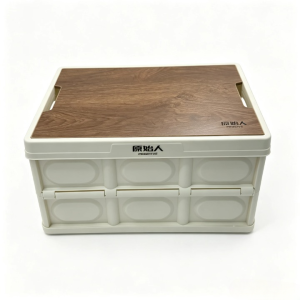
A kitchen only has so many good spots. The most accessible positions—front and center—should be reserved for things you use every day. Things you use often should stay out where you can reach them quickly. Less-used items can be put away in cabinets. Baking molds used once a week, specialty tools brought out once a month, and holiday items used once a year don’t belong in the front of your everyday drawer. They can go toward the back, or in cabinets you don’t open often. Overhead cabinets on both sides are good for larger, less frequently used items. Foldable storage bins are also useful for things you don’t need often but still want to keep. When you need them, unfold and fill them. When not in use, fold them flat and tuck them into a gap or the back of a drawer. Wall-mounted racks can also hold lightweight items, saving counter space without getting in the way.
Using tools and making the most of your space can help you clean up and organize the kitchen. But the real challenge is keeping it that way. The only way is to put things back where they belong after each use. It sounds simple, and it really isn’t that hard. When everything has a designated spot, putting it back takes almost no time at all. Items on the counter go back to their organizer, dishcloths get hung back on their hooks, pots return to their rack. That final step—putting things away—is what really keeps the kitchen clean and organized in the long run.