
Packing for 10 days does not mean packing 10 complete outfits. The key is to bring a small group of clothes that work together, wash a few essentials during the trip, and use your carry-on space carefully.
For most warm- or moderate-weather trips, a 10-day wardrobe can fit into one carry-on without feeling restrictive. The trick is to stop thinking in terms of “one outfit per day” and start consider reusable pieces, laundry, and flexibility.
The simplest way to pack for 10 days is to pack for about five days and plan to do laundry once.
A practical starting point is:
5–7 tops
2–3 bottoms
1–2 lightweight layers
5–7 sets of underwear and socks
1 versatile pair of shoes, plus a second pair only if your itinerary requires it
1 outer layer, preferably worn while traveling
The exact numbers depend on your destination and activities. A beach trip requires very different clothing from a business trip or a cold-weather vacation.
What matters is that each item should work with several others. Choose neutral bottoms and tops that can be mixed and matched rather than packing complete outfits. For example, three bottoms paired with six tops already give you plenty of combinations without carrying 10 separate outfits.
This is also where fabric matters. Lightweight, quick-drying clothing is easier to wash in a hotel sink and can often be ready to wear the next day. If you are traveling somewhere warm or humid, these fabrics can make a bigger difference than simply adding more clothes.
The same principle applies to shoes. Wear your bulkiest pair while traveling and only pack another pair if it serves a clear purpose. “Maybe I’ll need these” is usually how a carry-on gains several unnecessary pounds.
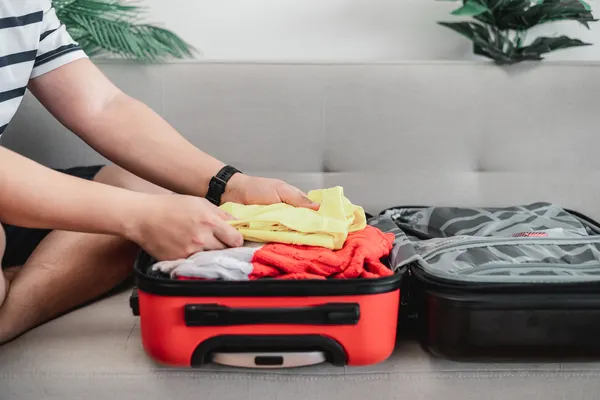
Once you have your basic wardrobe, edit it against your actual plans. Look at each day of the trip and ask three questions:
1. What will I be doing?
2. What will the weather be like?
3. What can I wear more than once?
This prevents the classic “just in case” problem.
If you are spending most of the trip sightseeing, you probably do not need multiple dressy outfits. If you have one nice dinner, one versatile shirt may be enough. If rain is likely, a lightweight waterproof layer is more useful than an extra sweater. A simple color system makes this easier. Pick two neutral colors and one accent color, then make sure most of your clothes work together.
For example: Black + beige + olive
Now a single pair of black trousers can work with several tops, while an olive overshirt can be worn over different outfits. You are not trying to create a fashionable capsule wardrobe for its own sake. You are reducing the number of decisions you have to make while traveling and eliminating clothes that only work in one specific combination.
Before packing, lay everything out on the bed. If you cannot imagine when you will wear an item, take it out. That final edit is often more effective than trying to find another clever way to squeeze it into your suitcase.
Once you have reduced the wardrobe, the next step is making good use of the space. There is no need to choose between rolling and folding. Use each method where it makes sense.
Roll T-shirts, underwear, socks, workout clothes, and other soft items. Fold shirts, trousers, and structured clothing that are more likely to wrinkle. Bulky soft items such as sweaters can go into a compression packing cube if the fabric can handle compression.
Packing cubes are particularly useful for keeping categories together. Instead of throwing everything into one large compartment, you can separate tops, bottoms, and smaller clothing. When you need to do laundry, you can pull out the relevant items without emptying your entire bag.
Heavy items should stay toward the bottom of the suitcase, close to the wheels. Keep things you may need during transit — such as a light layer, charger, toiletries, or a change of clothes — somewhere easy to reach.
But remember: packing technique cannot compensate for bringing too much. If your bag is already overflowing before you leave home, rolling your shirts more tightly will only solve the problem temporarily.
A carry-on-only strategy only works if your airline actually accepts your bag as a carry-on. Do not rely on a generic “standard carry-on size.” Airlines can have different limits for dimensions, weight, ticket types, routes, and cabin classes. On a multi-city trip, the most restrictive airline on your itinerary may determine what you can bring into the cabin.
Before packing, check the baggage policy for every flight and note:
IATA also recommends checking the baggage information provided by the airline because allowances vary between carriers and travel circumstances. Once you know the strictest limit, pack against that rather than assuming you will have extra room. A luggage scale is useful here. Weigh the bag before leaving home, especially if you are traveling internationally where weight restrictions can be stricter.
Also Read: Can You Put a Laptop in a Checked Bag? Everything You Need to Know Before Flying
There is one problem with packing for 10 days that is easy to overlook: your luggage does not necessarily stay the same size throughout the trip.
On the way out, your suitcase may contain only the clothes and essentials you packed at home. On the way back, you may have souvenirs, gifts, snacks, or simply clothing that takes up more space after being worn and washed.
That is where an expandable carry-on can be useful. The Foldable Space carry-on is designed to give you a more compact configuration when you need to stay within tighter cabin dimensions and additional space when your luggage requirements change.
Its listed weight is under 6.5 lb (2.9 kg), which can also be helpful when your airline imposes a strict total baggage weight. A lighter suitcase leaves more of that allowance available for the things you actually want to bring.
The important point is not to treat the expansion feature as an excuse to pack more. If the expanded bag exceeds your airline’s carry-on dimensions, keep it collapsed for the flight or be prepared to check it. The advantage is flexibility, not unlimited capacity.
For a 10-day trip, that flexibility can be especially useful when your outbound and return packing needs are different.
If you want to keep the whole process simple, use this formula:
Pack five days of versatile clothing → plan one laundry session → choose pieces that mix and match → wear your bulkiest items → limit shoes → pack against your strictest airline allowance → leave some room for the trip home.
That’s enough to handle most 10-day trips without turning your carry-on into a game of luggage Tetris. Packing light is not really about owning less clothing or learning a secret folding technique. It is about making every item work harder. When your clothes can be combined, washed, reworn, and layered, 10 days becomes much easier to manage in one bag.